A properly sized and installed BESS (Battery Energy Storage System) saves money on its own by storing low-cost or self-produced energy for use when it is needed most. But that is just the starting point. Without a system that decides when to charge, discharge, or remain idle at any given moment, the battery operates "blindly," following fixed rules and leaving significant potential savings and revenue on the table.
That is exactly the job of the BHive® Optimizer, the intelligence module that runs on the BHive® control layer, BeePlanet Factory's proprietary EMS. In this article, we explain what it is, how it makes decisions, and the value it provides, whether you are an installer or integrator proposing it to a client, or the system owner looking to understand what drives those savings.
A battery optimizer is software that autonomously and continuously decides how a storage system should charge and discharge to maximize its profitability, rather than simply following a schedule or a static rule (for example, "always charge at night").
The BHive® Optimizer relies on the BHive® control layer, which manages the installation locally, in real time, and independently of connectivity, adding an economic decision-making layer on top of that foundation. It does not replace the installation's control system; it makes it more profitable.
Contrary to common assumptions, this is not a generic artificial intelligence model applied to a battery, but rather the result of years of engineering on real-world installations, reviewed and fine-tuned project by project by the BeePlanet team. This foundation of real-world operation, backed by over 180 deployed projects and more than 80 MWh accumulated since 2020, is what enables reliable decision-making every 15 minutes, installation after installation.
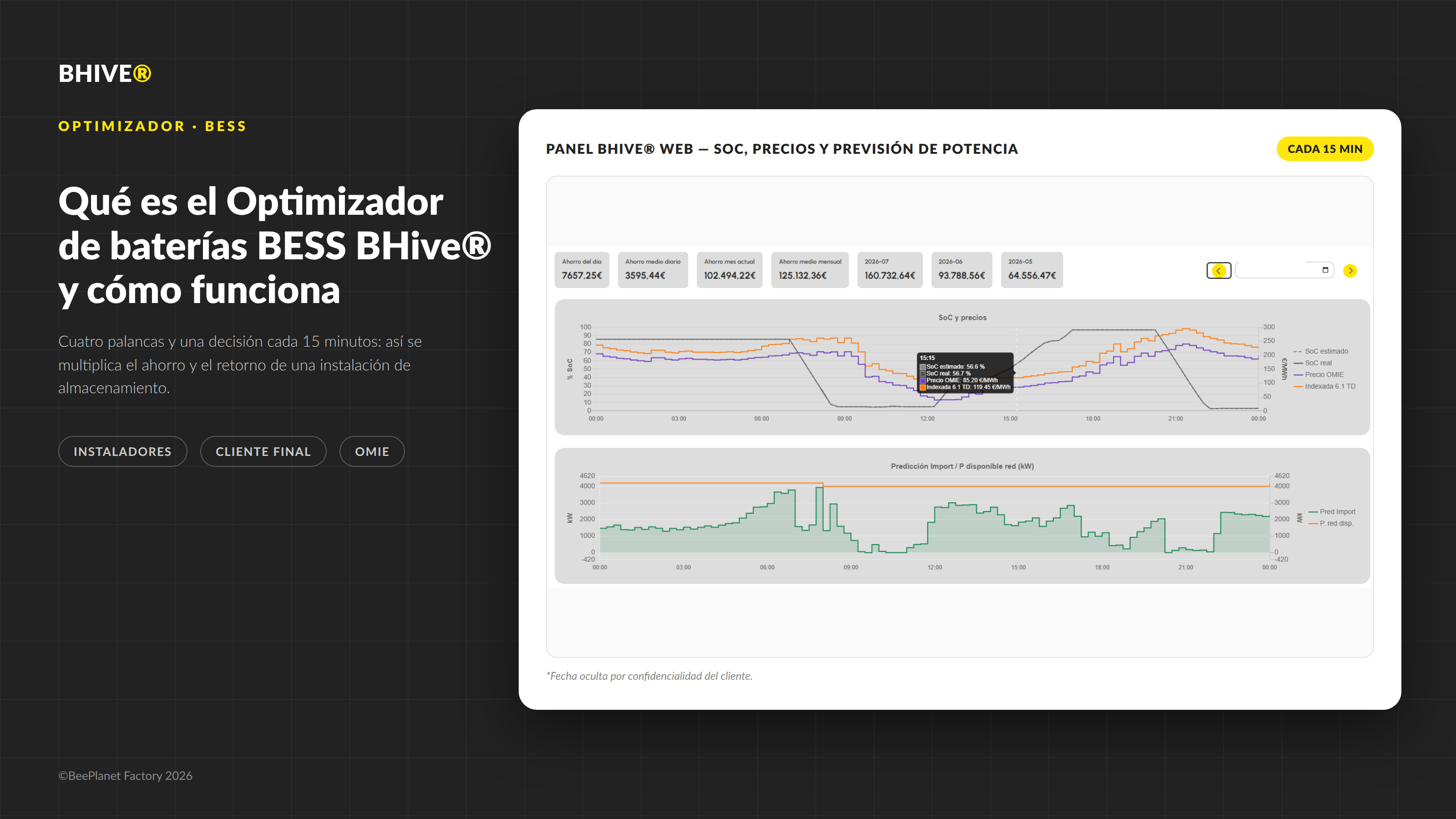
The Optimizer recalculates its charge and discharge strategy every fifteen minutes, combining four sources of information:
- 15-minute resolution. Each time slot is a new decision: charge, discharge, or wait, based on the market signal and the actual status of the installation at that moment. This allows for reacting to price or consumption changes much faster than a fixed hourly schedule.
- Photovoltaic generation and consumption forecasting. The system anticipates the plant's predictable behavior (consumption peaks, hours of peak solar production) using historical data, preparing the battery in advance rather than reacting too late.
- Market intelligence (OMIE). The Optimizer analyzes electricity market prices in real time and decides to charge when energy is cheap and discharge (or feed into the grid) when it is expensive, a process known as energy arbitrage.
- Battery health. Every charge/discharge cycle has a degradation cost. The Optimizer takes this into account when making decisions, ensuring the asset's lifespan isn't sacrificed for short-term savings, thereby protecting the long-term return on investment.
For the end customer
For the owner of a facility, such as an industry, a shopping center, or an energy community, the Optimizer delivers concrete results:
- Greater savings on your electricity bill by making better use of self-produced energy and buying/selling at the most favorable market times.
- New revenue streams beyond self-consumption: energy arbitrage and participation in system balancing services, where the installation allows.
- An asset that lasts longer, because charge and discharge decisions account for battery wear, not just immediate profit.
- Total visibility through the 24/7 BHive® web platform: real-time alerts, predictive maintenance, and comparisons between actual and optimized performance.
For the installer or integrator
For those who design, sell, or maintain BESS installations, the Optimizer is also a powerful commercial and technical asset:
- It is hardware-agnostic: compatible with inverters, batteries, and chargers from leading manufacturers, so you aren't tied to a single supplier.
- It provides a significant cybersecurity advantage: BHive® is ISO 27001 certified and uses encrypted communications via industrial protocols (OPC-UA, MQTT, Modbus TCP), a requirement increasingly demanded by clients.
- It reduces post-sales support work: local PLC control functions independently of connectivity, and the BeePlanet team provides remote support and monitoring for the installation.
- It allows you to support your project with real operational data, not just promises: the Optimizer's logic has been built and refined over years of experience and operation.


.png)




.png)


